
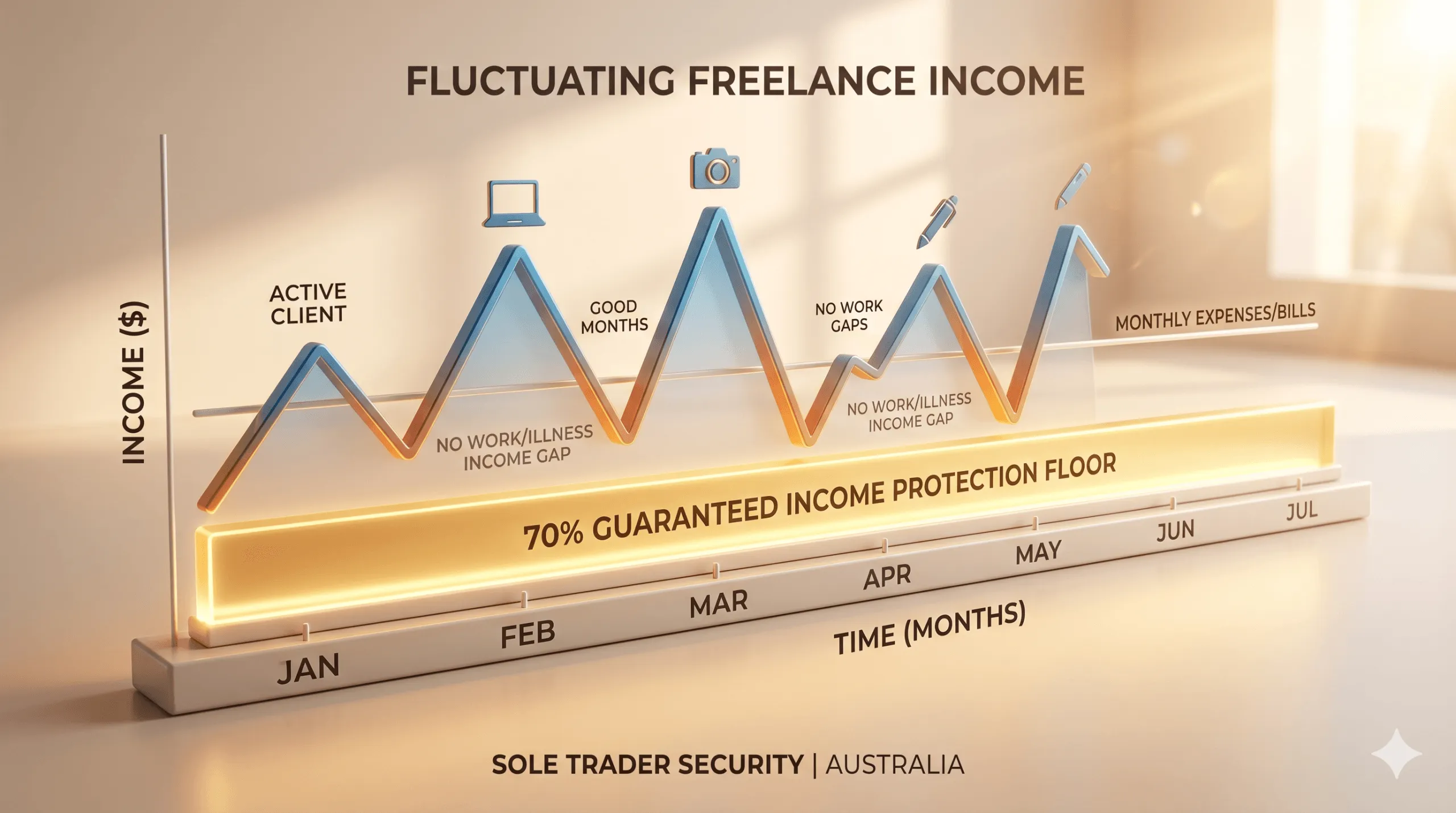
Income protection for freelancers in Australia provides a reliable monthly payout if a serious illness or injury prevents you from working. Because sole traders do not receive paid sick leave, a tailored policy replaces up to 70% of your average income, keeping your bills paid while you recover.
The Freelancer’s Reality: No Work, No Pay
When you work for yourself, you are the business. If a medical emergency stops you from sitting at your desk or meeting clients, your cash flow stops instantly. You cannot rely on employer-funded sick leave, long service leave, or annual leave to cover the rent, the mortgage, or your daily business expenses.
For standard employees, a broken wrist or a severe illness is a temporary setback cushioned by corporate benefits. For a freelancer, it is an immediate financial crisis.
How Income Protection for Freelancers Australia Works
Income protection is designed to act as your personal financial safety net. If your treating doctor declares you medically unfit to work due to sickness or injury, the policy pays a regular monthly benefit after a nominated waiting period.
For self-employed individuals, policies generally replace up to 70% of your pre-tax income. This money goes directly into your bank account. You have complete freedom to use it however you see fit, whether that means paying personal household bills, keeping your business subscriptions and software licences active, or paying for rehabilitation costs that Medicare does not cover.
How Your Business Structure Impacts Your Policy
The way you set up your freelance business directly impacts how insurers view your income and structure your policy. Here is how it breaks down across the three most common Australian freelance structures:
- Sole Traders
This is the most straightforward structure. Because your business income and personal income are treated as the same thing by the ATO, insurers will calculate your cover based on your net profit. This means your total business revenue minus all deductible business expenses.
- Company Directors (PTY LTD)
If you operate as a proprietary limited company and pay yourself a regular PAYG salary, your income protection will generally be based on that specific salary. However, if you leave profits in the company or pay yourself via dividends, the application process becomes more complex. You will need an insurer who is willing to look at your share of the business’s generated profits, not just your base salary.
- Partnerships
If you freelance with a partner, income protection only covers your individual share of the income. If you are injured and your partner continues to generate revenue for the business, calculating your precise loss of earnings requires a specialised policy structure.
Proving Your Freelance Income (The Indemnity Shift)
The biggest hurdle for self-employed workers is proving what they earn, especially since freelance income naturally fluctuates from month to month.
If you are researching this topic, you might read older articles mentioning “Agreed Value” policies. It is critical to know that following interventions by the Australian Prudential Regulation Authority (APRA) in 2020, Agreed Value policies are no longer available to new applicants.
Today, you will apply for an “Indemnity” policy.
With an indemnity policy, the insurer assesses your income at the time you actually make a claim, rather than the day you sign the contract. Because freelance revenue goes up and down, insurers understand that your income in the month prior to an injury might be unusually low. To account for this, most Australian insurers will look at your financial history over the past 24 to 36 months and calculate your average monthly income from your best consecutive 12-month period.
To verify these figures at claim time, you must keep pristine financial records. You will generally be required to provide:
- Your two most recent ATO Notice of Assessments.
- Full individual tax returns.
- Detailed Profit and Loss (P&L) statements, ideally signed off by a registered accountant.
Case Study: A Freelancer’s Claim in Action
To understand the practical value of this cover, let us look at a real-world scenario.
Meet David. He is a freelance web developer operating as a sole trader. After expenses, his net profit last financial year was $90,000. David holds an income protection policy with a 30-day waiting period.
Over the weekend, David has a severe mountain biking accident and shatters his right wrist. His specialist tells him he cannot type or use a mouse for at least three months.
Because David cannot generate revenue, he lodges a claim. The insurer calculates his maximum benefit at 70% of his $90,000 income. This equates to $63,000 annually, or $5,250 per month.
David waits out his 30-day qualifying period using his emergency savings. After that, he begins receiving $5,250 directly into his bank account every month until his doctor clears him to return to his keyboard. This allows David to pay his rent, buy groceries, and keep his web hosting accounts active without taking on high-interest credit card debt.
The “Offsets” Warning for Side Hustles
Many modern freelancers have diverse income streams. You might take on active client work, but also earn passive income from selling digital courses, e-books, or stock photography.
If you make a claim, you must be aware of “offset” clauses. If you are unable to do client work but your passive income streams continue to generate significant money while you are recovering, your insurer may offset (reduce) your monthly payout by the amount of passive income you are still receiving. Always review your Product Disclosure Statement (PDS) to confirm how your specific insurer handles passive business revenue.
Are the Premiums Tax-Deductible?
Yes. For Australian sole traders and freelancers, income protection premiums are generally fully tax-deductible if you pay for the policy out of your own pocket and hold the policy outside of your superannuation fund.
Claiming this deduction at tax time makes securing comprehensive cover significantly more affordable. However, the ATO rules state that because you claim a deduction on the premiums, any monthly benefit payments you receive during a claim must be declared as taxable income on your future tax returns.
Customising Your Policy to Fit Your Budget
Freelance budgets can be tight, but you can adjust two main levers to make your premium more affordable:
- Waiting Period: This is the amount of time you must be medically unfit to work before the payments start. Standard options are 14, 30, 60, or 90 days. If you have an emergency fund saved up to cover two months of expenses, choosing a 60-day or 90-day waiting period will drastically reduce your monthly premium.
- Benefit Period: This dictates how long the policy will continue to pay you if you remain permanently unable to work. Standard options range from one year, two years, five years, or right up to retirement age (usually 65). Shorter benefit periods result in cheaper monthly premiums.
The Digital Nomad Dilemma
If you run your freelance business while travelling the globe, you need to be extremely careful with policy definitions. Many Australian insurers require you to be physically residing in Australia for a minimum number of months per year to keep your cover valid.
If you are injured overseas, some policies will only pay benefits for a restricted period (often three to six months) unless you return to Australia for treatment. Always inform your broker if you plan to work remotely from another country to secure a policy that aligns with your lifestyle.
Frequently Asked Questions
Can I pay for my policy directly from my business bank account?
If you operate as a sole trader, you can generally pay your premiums from your business account, as the ATO views you and the business as the same entity. However, the policy must be owned in your personal name. If you operate a PTY LTD company, having the business pay for a policy owned by the company can trigger complex Fringe Benefits Tax (FBT) implications. Always consult your accountant before setting up your payment structure.
Does income protection cover a lack of client work?
No. This is a very common misconception. Income protection only triggers if you suffer a severe illness or a physical injury that stops you from working. It does not act as unemployment insurance, and it will not pay you if you simply lose a major client, experience a quiet season, or face a general downturn in freelance work.
Can I hold my freelancer policy inside my superannuation?
Yes, you can hold income protection inside your super fund, and the premiums will be deducted from your super balance rather than your daily cash flow. However, policies held inside Super are governed by strict Superannuation Industry (Supervision) Act (SIS) rules. The definitions of disability are often much stricter, and the benefit periods are usually capped at two years. Many freelancers opt for retail policies outside of super to secure superior definitions and longer payment periods.
Why Compare with Spotter Life?
- Backed by Real Reviews: 4.8/5 from 496 reviews. We rely on verifiable feedback, not marketing fluff.
- Licensed Experts: Operating under Australian Financial Services Licence 540383.
- Streamlined Process: We help you navigate the market, save time, and secure comprehensive coverage without the hassle.
How it Works
- Get a Soft Quote: Take a minute to fill out our quick, low-friction form.
- Apply Over the Phone: If the numbers look right, jump on a call with our team to formalise your application.
- Get Protected: Sit back while we process the paperwork and get your policy in place.