
A few months ago, I sat down with a mate who was stressing over his family budget. Between his mortgage, rising grocery costs, bills, and the kids’ school fees, things were tight. He knew he needed proper Total and Permanent Disability (TPD) insurance to protect his family if he ever got hurt and couldn’t work.
The problem? The quote he got for a standalone policy outside of superannuation was over $180 a month. He looked at the paperwork, sighed, and said, “I want to protect my family, but I just can’t justify taking that much money out of our account right now.”
That conversation highlights the exact trap so many Australians fall into. You are usually forced to choose between two frustrating options.
- Option A is relying on the default cover inside your super fund. It feels free because the premiums come straight out of your retirement balance, but it comes with a major legal catch. The policy is strictly locked to an “Any Occupation” definition.
- Option B is paying for a standalone policy out of your personal bank account. This unlocks the better “Own Occupation” definition, but it puts a heavy ongoing strain on your monthly household budget.
Most direct-to-consumer comparison sites will tell you those are your only two choices.
However, experienced insurance advisers use a third, much smarter approach known as super-linked TPD insurance (also called split TPD cover). This setup allows you to secure the top-tier “Own Occupation” definition while paying up to 80% to 90% of the bill directly from your super balance.
Here is how this split structure works, what the numbers actually look like for a normal family budget, and why your standard super fund rarely mentions it.
The Legal Catch: TPD Inside vs Outside Super
To understand why split cover exists, it helps to look at the law behind it: the Superannuation Industry (Supervision) Act 1993 (SIS Act).
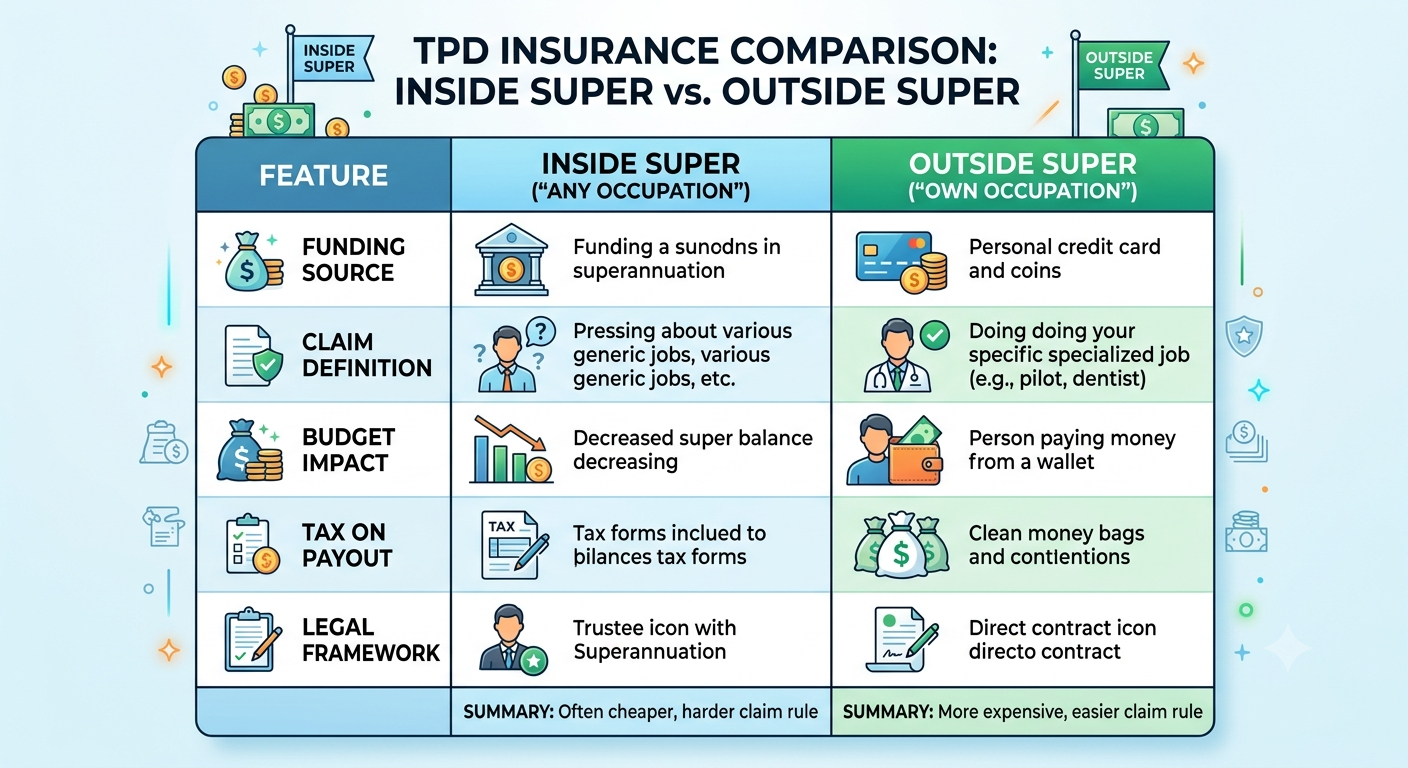
Under federal law, super funds are legally banned from offering insurance policies that pay out under an “Own Occupation” rule. If your retirement savings are paying the premium, the policy must meet strict government regulations. To get a payout, you must be disabled to the point where you are unlikely to ever work again in any job suited to your education, training, or experience.
| Feature | Inside Super (“Any Occ”) | Outside Super (“Own Occ”) |
| Funding Source | Superannuation balance | Personal bank account |
| Claim Rule | Unlikely ever to engage in any occupation for which you are reasonably suited by education, training, or experience | Unlikely ever to return to your specific occupation at the time of injury or illness |
| Budget Impact | Zero immediate out-of-pocket cost | High ongoing monthly expense |
| Tax on Payout | Can be subject to super withdrawal tax | Generally, 100% tax-free |
What “Any Occupation” Looks Like in Real Life
The difference between these two definitions is not just fine print; it is real life. I have seen families left completely devastated because they didn’t fully understand what you should be covered for with TPD until it was too late.
Think about a carpenter or an electrician who has spent fifteen years on the tools. One bad fall off a scaffolding ladder ruins his lower back. His specialist confirms he can never work on a building site again.
He applies for his TPD payout through his industry super fund, expecting the money he has paid for over a decade. Instead, the fund’s trustee reviews his claim and argues that because he knows how to read site plans and manage suppliers, he is perfectly capable of sitting at a desk answering phones for a hardware company. The claim is denied because he technically does not meet the strict guidelines for what conditions qualify for a TPD payout under an “Any Occupation” definition.
Or take an experienced dental hygienist or surgical nurse who develops a severe hand tremor. They can no longer treat patients safely. Yet, under an “Any Occupation” super policy, the insurer can argue they are qualified to teach medical students at TAFE or work in pharmaceutical sales.
They lose their career, their income drops dramatically, and their insurance pays them nothing.
The Solution: How Super-Linked TPD Works
Super-linked TPD insurance solves this problem by legally linking two separate policies together: one inside your super fund, and a small companion policy outside in your personal name.
Instead of buying one expensive direct policy, your adviser sets up a split contract:
- The Main Policy (Inside Super): The bulk of your insurance is set up inside your super fund. This covers the basic “Any Occupation” requirement. Because this follows federal law, your super fund pays this large portion of the premium using your pre-tax retirement balance.
- The Linked Rider (Outside Super): A small connected policy is set up directly in your name outside of super. This rider has one simple job: it upgrades your cover from “Any” to “Own”. You pay for this tiny upgrade portion out of your everyday bank account.
What happens if you need to claim?
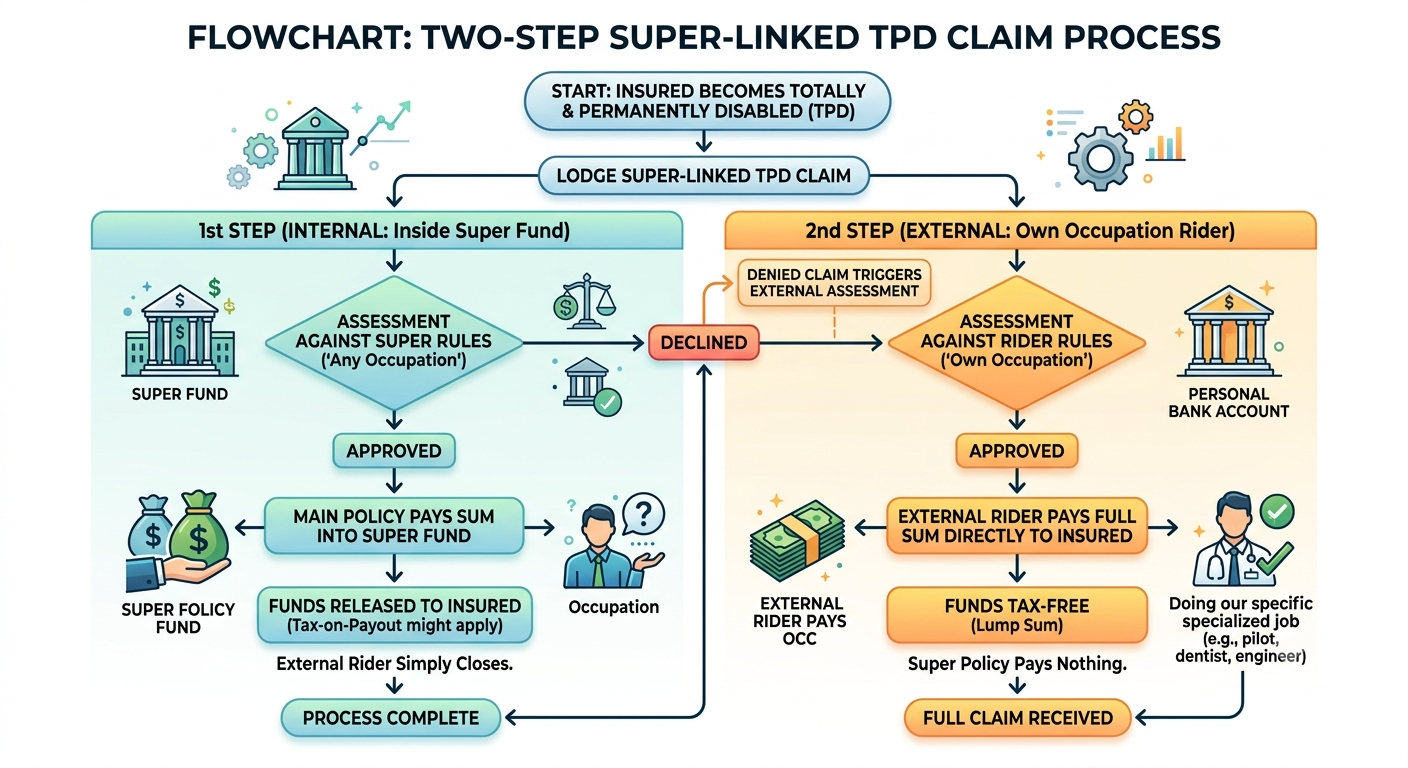
If you suffer a permanent illness or injury, your claim goes through a simple two-step process:
- Scenario A (You meet the strict “Any Occ” rule): The main policy inside your super pays the lump sum into your super fund, and the money is released to you under standard rules. The external rider simply closes.
- Scenario B (You can work some desk job, but can never do your specific job): The base super policy declines the claim due to government rules. Immediately, your personal external rider catches that denied claim and pays the full insured lump sum directly into your bank account, completely tax-free.
You get the exact same financial security as an expensive standalone policy, but your family’s weekly budget barely feels it.
Looking at the Real Savings
Let’s look at how this actually plays out on a kitchen-table budget for a $1,500,000 TPD policy for a 40-year-old professional.
Assume the full retail price for a proper “Own Occupation” policy is $2,200 a year.
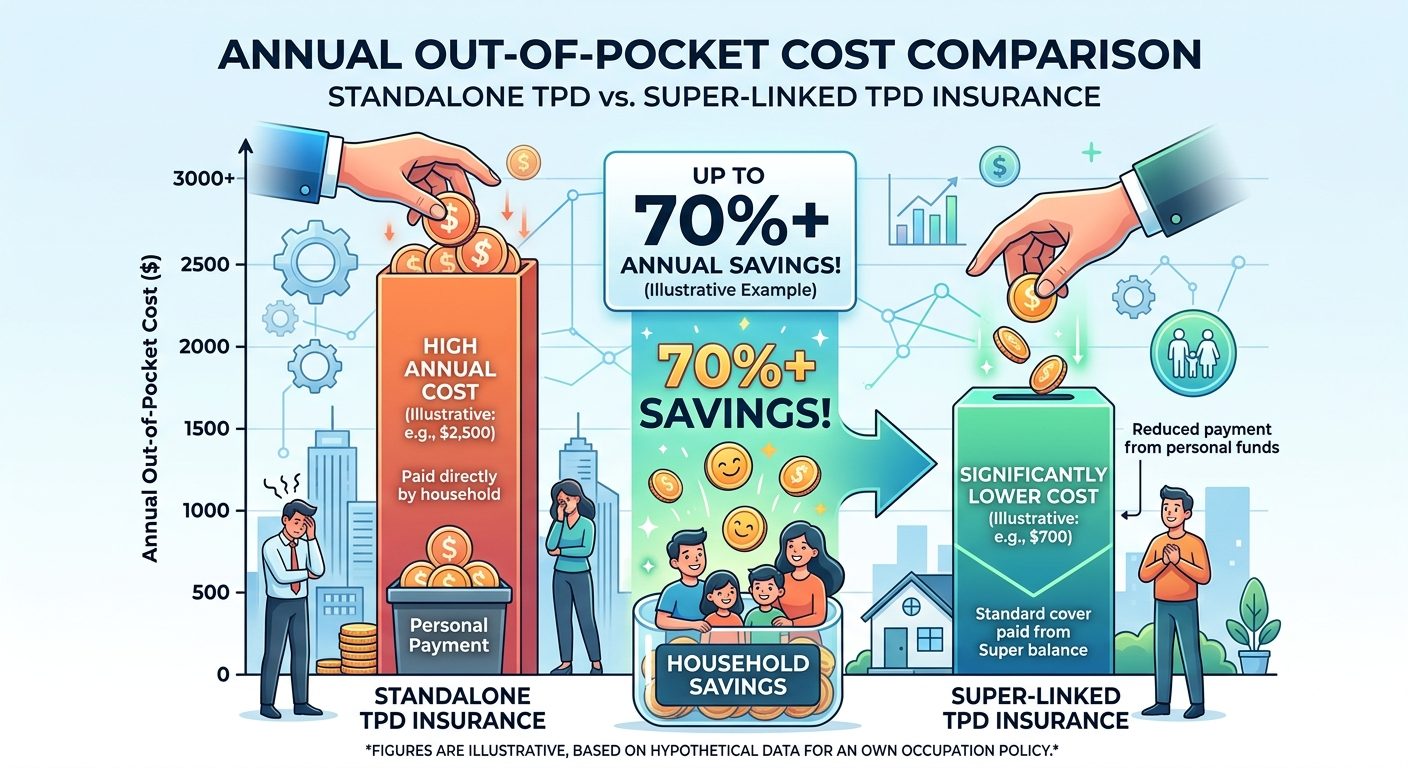
Option 1: 100% Outside Super (Standard Direct Buy)
- Super Fund pays: $0
- You pay out-of-pocket: $2,200 a year ($183 a month)
- The Verdict: This puts a heavy squeeze on your family budget. Over fifteen years, this costs you $33,000 in personal cash.
Option 2: 100% Inside Super (Standard Automatic Cover)
- Super Fund pays: ~$1,600 a year (cheaper because the cover is weaker)
- You pay out-of-pocket: $0
- The Verdict: It feels great today, but it leaves your family exposed to a rejected claim if the insurer decides you can work a lower-paying call centre job.
Option 3: Super-Linked TPD (The Smart Split)
The insurer calculates the cost of the basic cover versus the upgrade. Usually, the split lands around 82% inside super and 18% outside super.
- Super Fund pays (Main bit): $1,804 a year (paid from your super balance)
- You pay out-of-pocket (Upgrade bit): $396 a year ($33 a month)
- The Verdict: You secure the exact same $1.5M “Own Occupation” protection as Option 1, but you keep $1,804 in your personal bank account every single year.
Over that same fifteen-year period, you keep $27,060 in your household bank account while making sure your family is properly protected.
Three Things to Keep in Mind
While this setup is fantastic for your cash flow, it does require proper management.
1. Keep an eye on your retirement balance
Because the main premium is paid from your super balance, it slowly reduces your retirement savings over time. If you only have a small super balance (say, under $40,000), paying insurance premiums out of it can slow down your investment growth. I always suggest talking to your adviser about setting up a small salary sacrifice contribution (even $30 a week) to put that premium money right back into your fund.
2. Tax rules depend on where the money lands
If your claim is paid out through your super fund (Scenario A) before you reach age 60, part of that lump sum can be taxed at up to 22% (including the Medicare Levy). On the other hand, any money paid out through your personal external rider (Scenario B) goes straight into your bank account and is completely tax-free.
3. Standard online calculators can’t quote this
If you jump online, you won’t see a button to calculate “Super-Linked TPD” costs.
Some standard comparison websites run on automated algorithms designed to sell quick, off-the-shelf policies. Setting up a split policy requires a real person. A qualified broker has to review your super fund, match policy numbers across two different billing systems, and manually structure the legal definitions so they protect you properly.
Protect Your Career Without Breaking the Bank
You work hard to provide for your family. You shouldn’t have to choose between protecting your income and paying your electricity bill.
If you are currently paying for an expensive standalone policy out of your own pocket, you are likely spending thousands of dollars more than you need to. If you are just relying on your super fund’s default cover, you are paying for a policy that might legally walk away from you when you need it most.
There is a better way to do this.
Reach out to the team at Spotter Life for a chat. We can look at your current super fund, map out the exact premium split for your occupation, and help you get proper “Own Occupation” cover that fits comfortably into your family budget.