I am Harley West, Managing Director of Spotter Life and Spotter Finance. Over the last decade of working in the Australian financial sector, I have sat down with countless self-employed professionals to help them protect their hard-earned livelihoods.
A few weeks ago, I caught up for coffee with a self-employed specialist IT consultant. Let us call her Sarah. Sarah has a fantastic but highly variable income. She takes on massive, lucrative corporate contracts one quarter and enjoys a much lighter, relaxed workload the next. To save some money on her monthly overheads, she was seriously thinking about cancelling her old 2018 income protection policy and switching to a cheaper, modern one she found online.
I asked if she knew the structural difference between her old agreed value contract and the new indemnity policies sold on the market today. She did not. If she had cancelled that old policy, a health claim during a slow billing month could have left her seriously underinsured and struggling to pay her mortgage.
If you are a high earner with a fluctuating income, the way your insurer assesses your earnings is just as important as the payout amount itself. A policy is only as good as the mechanics powering it behind the scenes. This brings us to the biggest, most impactful debate in personal insurance for the self-employed: agreed value versus indemnity income protection.
The 2020 APRA Rule Change: What Happened to the Market?
Before we look at which structure is better for your specific cash flow, you need to understand the current regulatory rules in Australia. The landscape of income protection changed dramatically a few years ago, and understanding this history is vital for making smart financial choices today.
For years, Australian life insurers were losing billions of dollars on income protection claims. The policies were incredibly generous, and people were staying on claim for much longer than actuaries had predicted. Following major regulatory interventions by the Australian Prudential Regulation Authority (APRA) in 2020, insurers were forced to completely overhaul their product designs to ensure the industry remained sustainable. As part of this sweeping reform, insurers are no longer allowed to sell new Agreed Value policies.
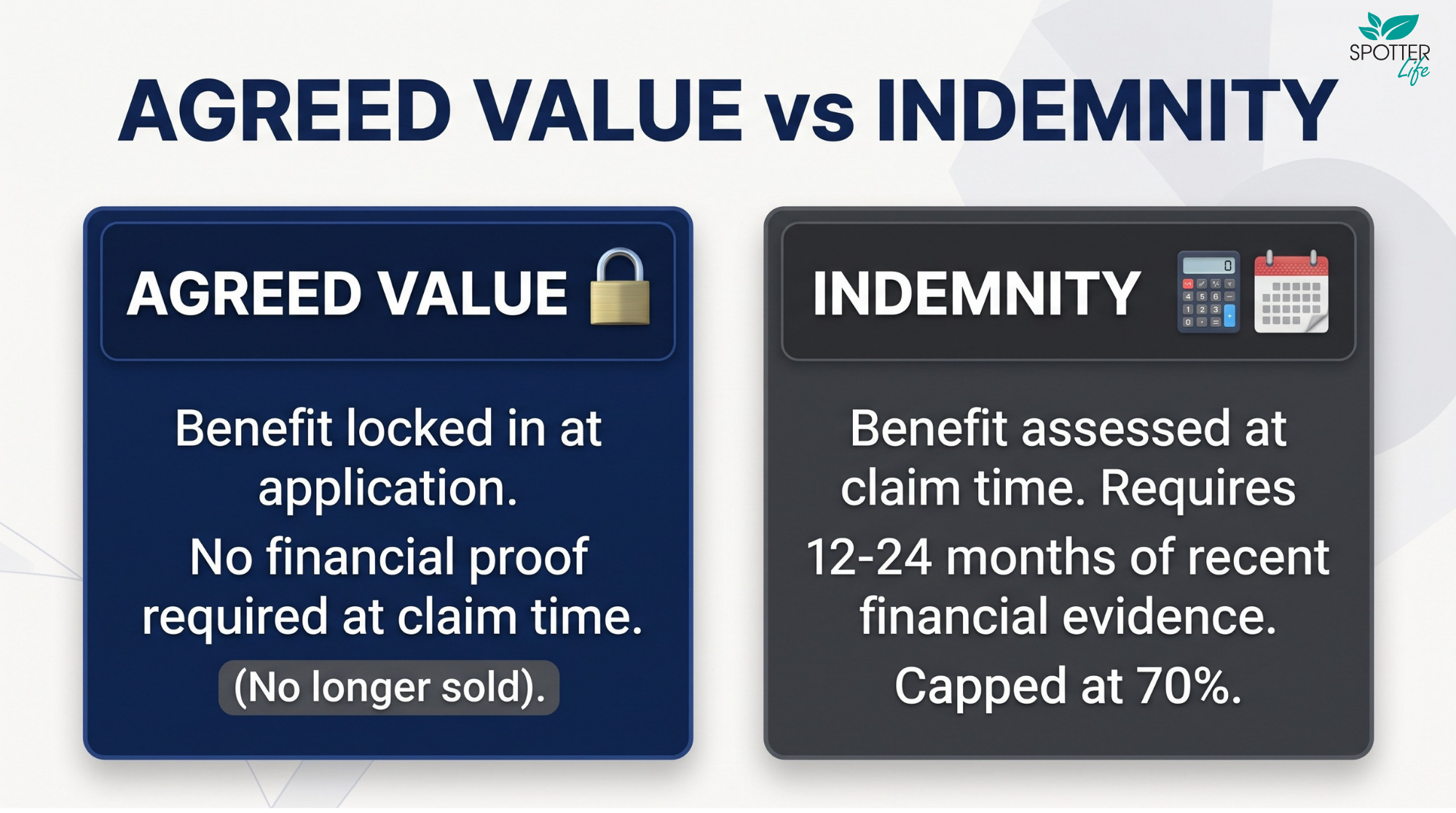
Today, all new retail applications across the country are strictly for Indemnity policies. These modern policies also generally cap your maximum income replacement at 70% of your gross pre-tax salary. However, if you are lucky enough to hold an older Agreed Value policy purchased before the ban, you might still have access to the legacy 75% tier.
What is Agreed Value Income Protection?
Before the 2020 APRA ban took effect, Australians could buy Agreed Value policies. These contracts locked in your monthly payout based on your salary on the exact day you signed the paperwork.
When you applied, you provided the insurer with your tax returns and financial evidence proving your income at that specific point in time. Once the underwriter accepted those figures, your monthly benefit was guaranteed.
For self-employed workers, locums, and contractors with variable incomes, this offered absolute, unwavering peace of mind. Let us look at a practical example. Imagine you had an exceptional financial year in 2018, earning a high six-figure sum. You applied for an Agreed Value policy and locked in a high monthly benefit of $10,000.
If your business hit a slow period three years later, dropping your recent income significantly, and you suddenly needed to claim due to a severe injury, your payout remained fixed at that original $10,000 amount. You did not have to prove your recent reduced earnings to the insurer. The value was already agreed upon. The certainty this provided to business owners was unmatched because it entirely removed the stress of income fluctuations from the claims process.
What is Indemnity Income Protection?
Under a modern Indemnity policy, the mechanics are entirely reversed. The insurer does not guarantee a specific payout amount when you apply. Instead, they assess your income at the exact time you make a claim.
If you suffer an injury or illness that stops you from working, the insurer will request your financial records over the preceding 12 to 24 months to calculate your average earnings leading up to the event. They will then apply your policy’s percentage cap (usually 70%) to that recent average.
For self-employed professionals, locums and freelancers whose income bounces around depending on contract availability, seasonal demand, or extended holidays, this creates a very real financial trap.
Let us revisit our previous example. Imagine you have a modern Indemnity policy. You take a few months off to travel or experience a quiet patch in your consulting business, resulting in a lower-than-average annual income. If you suddenly suffer a severe back injury and need to claim, the insurer will look at your recent lean period. Your payout will reflect that recent lower average, significantly reducing your monthly benefit right when you need the money the most.
The Heavy Paperwork Burden of Indemnity Claims
Beyond the risk of a lower payout, Indemnity policies also bring a heavy administrative burden at the worst possible time. Keeping perfect, up-to-date financial records is absolutely vital for a smooth claim process.
Because the insurer needs to calculate your pre-disability income at the time of the claim, you will need to provide extensive documentation. This often includes recent tax returns, profit and loss statements, Business Activity Statements (BAS), and accountant-verified documentation. If your books are messy or you are behind on your tax lodgements, your claim payments could be severely delayed.
When you are lying in a hospital bed or recovering from a major surgery, the last thing you want to do is chase your accountant for updated financial statements. This is why understanding the mechanics of your policy is so critical.
Which Protects Your Income Better?
The answer to this question depends entirely on when you bought your policy and how you manage your business cash flow today.
If you hold an existing Agreed Value policy, it is incredibly valuable. For self-employed individuals, it undeniably offers superior protection purely because of the guaranteed payout certainty. It acts as a financial anchor in a sea of variable business revenue. Because APRA banned the sale of new ones, these legacy contracts are like gold dust.
I tell my clients to think very carefully before cancelling an old Agreed Value policy or letting it lapse to chase a cheaper premium. Once that policy is gone, you cannot buy it back. You will be forced into the modern Indemnity market, permanently exposing your fluctuating income to claim-time assessments.
If you are applying for a new policy today, Indemnity is your only option. However, that does not mean you are left vulnerable. The focus simply shifts to optimising your application and structuring your policy carefully to protect your variable earnings.
How to Structure a Modern Indemnity Safety Net
You can still build a highly robust safety net using modern Indemnity policies. You just need to know which levers to pull and which clauses to look for in the Product Disclosure Statements.
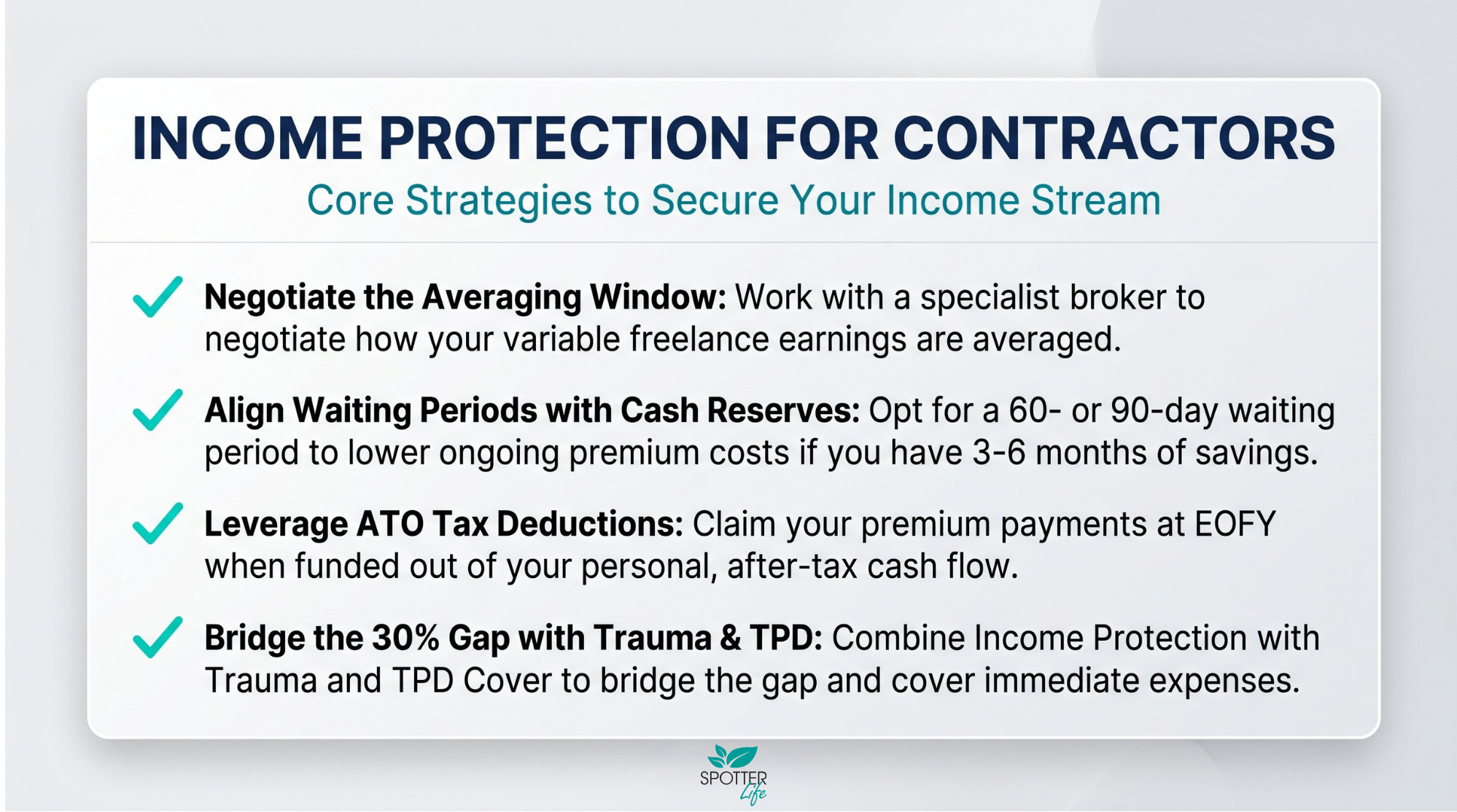
Here is how we structure modern cover for high-earning contractors to compensate for the lack of agreed value:
- Negotiate the Averaging Window (The Lookback Period). Not all Indemnity policies are created equal. Basic direct policies often strictly look at your income over the 12 months immediately prior to your claim. If you had a bad year, you are stuck with a bad payout. However, top-tier retail insurers offer much more flexible “lookback” periods. Working with a specialist broker allows you to access policies that calculate your pre-disability income based on your best consecutive 12 months within the last two or even three years. This crucial feature smooths out seasonal highs and lows, ensuring a lean quarter does not destroy your payout.
- Align Waiting Periods with Your Cash Reserves. The waiting period is the length of time you must be medically unfit to work before the insurer begins calculating your payments. If you have three to six months of living expenses saved in your bank account or a mortgage offset, choosing a 60-day or 90-day waiting period will drastically reduce your ongoing premium costs. You take on the short-term risk using your own savings, and the insurer takes on the catastrophic long-term risk.
- Leverage Tax Deductions. For sole traders and self-employed professionals, income protection is generally viewed as a necessary expense to protect your assessable income. Explicitly following ATO guidelines, you can typically claim these premium payments at the end of the financial year, provided you pay for the policy out of your own personal cash flow. For a deeper dive into how this works, read our guide to understanding if your income protection is tax deductible.
- Bridge the Gap with Trauma and TPD Cover. Because modern income protection caps your replacement at 70%, high earners often feel the pinch of that missing 30%. To bridge this gap and cover immediate medical expenses, we often structure a combined safety net. Adding trauma cover provides a tax-free lump sum upon the diagnosis of a critical illness like cancer or a heart attack. Similarly, establishing robust Total and Permanent Disability (TPD) cover ensures your family is protected if an injury is so severe that you can never return to your profession again.
For a broader understanding of how all these elements fit together, explore our complete income protection guide in Australia.
Smarter Protection, Made Easy
You do not have to spend your weekends reading confusing legal documents or worrying about how an underwriter will view your variable business revenue. Your focus should be on growing your business and enjoying your downtime, not second-guessing your financial safety net.
At Spotter Life, we specialise in risk mitigation at the exact intersection where your personal wealth meets your business cash flow. We know how to navigate the complexities of fluctuating incomes, lookback periods, and APRA regulations to ensure your cover actually responds to your real-world lifestyle when you need it most.
If you are a high-income earner, a locum, or a self-employed contractor looking to protect your livelihood, contact our team today. We can review your current setup or help you build a new, optimised policy from the ground up.
Compliance & General Advice Notice: Spotter Finance Pty Ltd (ABN 34 617 912 053) Australian Financial Services Licensee Number (540383) is authorised to provide general advice in superannuation and life insurance products only. Any information or advice contained on this website is general in nature and has been prepared without taking into account your objectives, financial situation or needs. Before acting on any information or advice on this website, you should consider the appropriateness of it having regard to your circumstances and read the offer document before acquiring products named on this website.
Compare Income Protection Side-by-Side
Don’t leave your financial safety net to chance. Let our specialists navigate the complex APRA indemnity rules and negotiate your true pre-disability earnings.
|AFSL 540383