
General Advice Warning: Spotter Finance Pty Ltd (ABN 34 617 912 053 | AFSL 540383), trading as Spotter Life, provides general advice in risk insurance products only. The information below does not take into account your personal objectives, financial situation, or needs. Always read the relevant Product Disclosure Statement (PDS) before making a decision.
Ask most Australians what trauma insurance is, and they will likely give you a straightforward answer: it’s a policy that pays out a lump sum of money if you get seriously sick.
While that is the core concept, the reality of claiming on trauma cover—often called crisis recovery insurance—is far more nuanced. One of the most common and devastating mistakes policyholders make is assuming that a simple diagnosis from a doctor automatically guarantees a full cheque from the insurer.
It doesn’t. In the world of life insurance, severity is everything.
Understanding the specific trauma insurance conditions covered in Australia, and exactly how insurers define them, is the difference between having the funds to focus entirely on your recovery and being left fighting a denied claim. Here is a technical breakdown of how trauma definitions work and why the distinction between a partial and a full payout matters.
What Are the Standard Trauma Insurance Conditions Covered in Australia?
Trauma insurance is specifically designed to provide a financial safety net (a tax-free lump sum) when you suffer a critical, life-altering medical event. You can use this money for anything: funding out-of-pocket medical treatments, modifying your home, taking time off work to recover, or paying down your mortgage.
While top-tier retail policies from Australia’s leading insurers can cover upwards of 40 to 50 specific medical events, the vast majority of claims stem from just three conditions:
- Cancer: Excluding some early-stage or non-invasive cancers.
- Heart Attack: Myocardial infarction meeting specific severity thresholds.
- Stroke: Resulting in permanent neurological damage.
Other standard trauma insurance conditions covered in Australia typically include:
- Coronary artery bypass surgery
- Major organ failure (kidneys, liver, lungs, heart)
- Severe burns
- Multiple Sclerosis (MS)
- Major head trauma
- Loss of speech, sight, or hearing
The Devil is in the Detail: Crisis Recovery Definitions
The most critical component of your trauma policy is not the marketing brochure; it is the Product Disclosure Statement (PDS).
Insurers rely on strict crisis recovery definitions to determine if you are eligible for a claim. Simply being diagnosed with a condition is rarely enough. The medical event must meet the exact clinical criteria outlined in your specific policy.
Furthermore, some insurers have superior definitions for certain demographics. For instance, one insurer on our panel might have highly favourable crisis recovery definitions for female-specific conditions, while another might offer broader coverage for cardiovascular events, making it a better choice for males with a family history of heart disease.
The “Severity” Table: How Insurers View Medical Events
| Medical Event | The “Broad” Diagnosis | The Insurer’s PDS Definition (Example) |
| Heart Attack | Patient experienced chest pain; doctors confirm a minor heart event. | Requires specific elevation of cardiac biomarkers (Troponin) and evidence of new ECG changes. |
| Cancer | Patient is diagnosed with early-stage melanoma. | Malignant tumour characterised by the uncontrolled growth of cells. Excludes Melanoma less than 1mm maximum thickness (Breslow). |
| Stroke | Patient suffered a Transient Ischaemic Attack (TIA or “mini-stroke”). | Neurological deficit lasting at least 24 hours, with evidence of infarction or haemorrhage on an MRI/CT. Excludes TIAs. |
Note: These are generalised examples. Exact definitions vary significantly between the 9 retail providers on the Spotter Life panel.
Partial vs. Full Trauma Payout: What’s the Difference?
Because medical science has advanced so rapidly, conditions that were once considered fatal or permanently disabling are now often caught early and treated successfully. To adapt to this, insurers introduced the concept of the partial vs. full trauma payout.
The 100% Full Payout
If you suffer a critical illness that meets the strictest definitions in the PDS (e.g., a massive heart attack resulting in permanent damage to the heart muscle, or advanced-stage cancer), your policy will pay out 100% of your insured amount. If you are insured for $500,000, you receive $500,000, and the trauma portion of your policy concludes.
The Partial Payout (Proportionate Benefit)
If you suffer a medical event that is serious but caught early or deemed less severe (e.g., early-stage prostate cancer, a minor heart attack, or losing sight in only one eye), the policy may trigger a partial payout.
Typically, a partial payout is calculated as 10% to 25% of your total sum insured, usually capped at a maximum dollar amount (often $50,000 or $100,000).
The benefit of a partial payout is twofold:
- You receive immediate financial relief to cover your initial treatment and short-term time off work.
- Your policy remains active. If your condition later worsens and meets the “Full Payout” definition, or if you suffer an entirely different severe trauma down the track, you can still claim the remaining balance of your policy.
Real-World Example: The Heart Attack Scenario
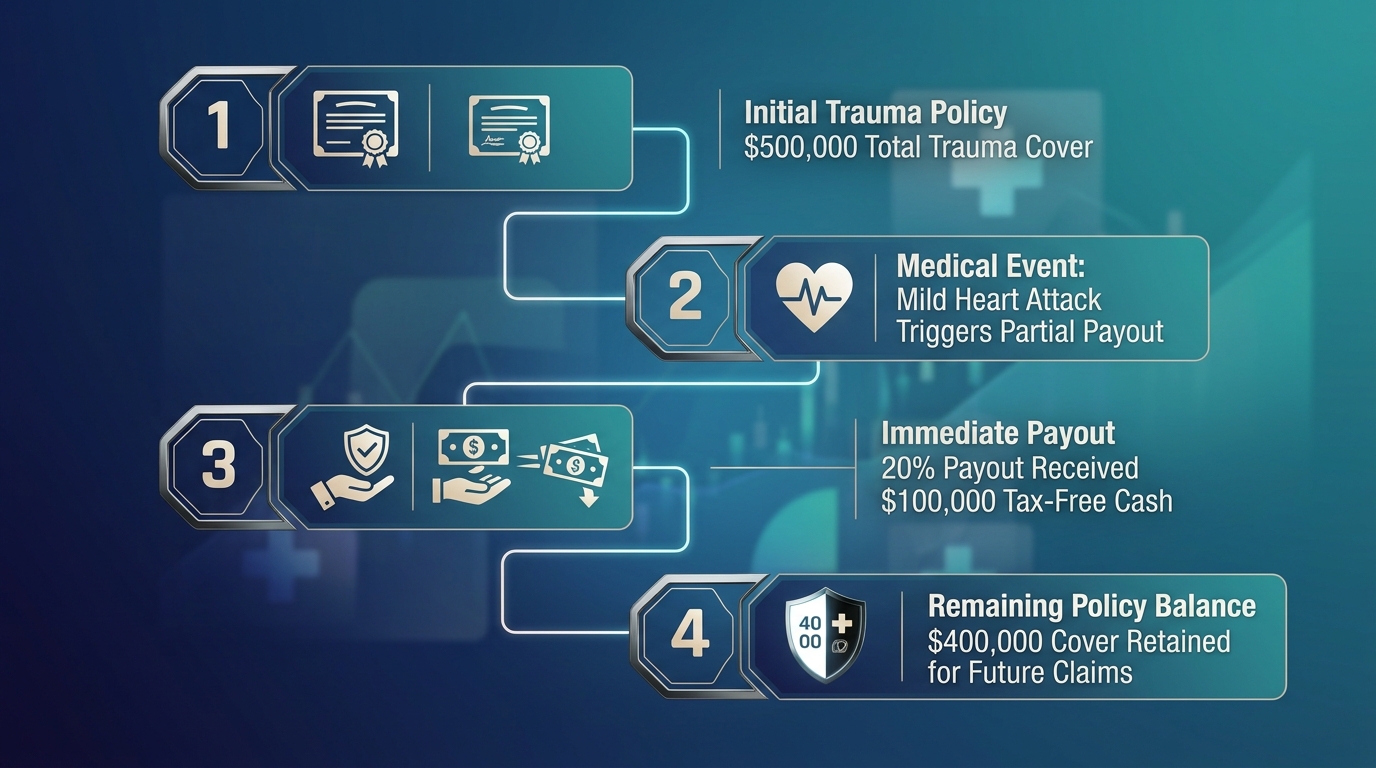
Imagine you hold a $500,000 Trauma Insurance policy.
You suffer a mild heart attack. You are rushed to hospital, treated quickly, and discharged a few days later with instructions to rest for a month. Because the event was mild and your heart muscle recovered quickly, it does not meet the insurer’s definition for a “Full” payout.
However, it does meet the definition for a “Partial” payout. The insurer pays you 20% of your sum insured ($100,000). You use this tax-free money to cover your mortgage and living expenses while you take three months off work to focus entirely on cardiac rehabilitation.
You still retain $400,000 in trauma cover for the future.
Why You Need an Expert to Read the PDS
Insurance policies are legal contracts, and the fine print is unforgiving. If you buy a generic, off-the-shelf policy direct from a website, you are rolling the dice on how that specific insurer defines a “severe” illness.
At Spotter Life, our experts don’t just look at the premium cost; we compare the underlying medical definitions across Australia’s top 9 retail life insurers. We navigate the complexities of partial vs. full trauma payouts to ensure that if the worst happens, your policy performs exactly the way you expect it to.
Frequently Asked Questions
Do I need to be unable to work to claim Trauma Insurance?
No. Unlike Income Protection or Total and Permanent Disability (TPD) cover, trauma insurance is not tied to your ability to work. It pays out upon the diagnosis of the defined medical condition, even if you make a full recovery and return to work the following week.
Is there a waiting period for Trauma Cover?
Yes. Almost all trauma policies in Australia have a 90-day qualifying period. If you suffer a heart attack, stroke, or are diagnosed with cancer within the first 3 months of the policy starting, you cannot claim.
Are Trauma Insurance premiums tax-deductible?
Generally, no. Because the lump-sum payout is delivered entirely tax-free to you, the Australian Taxation Office (ATO) does not allow individuals to claim the policy premiums as a tax deduction.
Need a review of your current cover or looking to set up a new policy? Contact the Spotter Life team today on 1300 793 143 to compare the market and find the right crisis recovery definitions for your situation.